












 en
Your cart
There are no more items in your cart
419.90 €

If you search for "best standing desks", you get lists of ten models with almost identical specs. The problem is that everyone needs a different desk. A setup with two monitors and a tower doesn't ask for the same thing as someone working from home in a small flat, or someone who is 1.60 m tall. That's why this guide works backwards: your case first, then the desk.
Most people are best served by a dual-motor electric standing desk with these features:
From there, three things decide the rest: your height (it determines how many column stages you need), the space you have and what you'll put on top.
Before looking at any model, grab a tape measure:
Those two numbers are the heights you need, and the desk's range has to cover both. Almost everyone looks only at the maximum height. The number that matters most is usually the minimum, because sitting is where you spend most of your hours.
| What to look for | What we recommend | Why |
|---|---|---|
| Motor | Dual motor | Smoother, more balanced lifting, and it copes better with unevenly distributed weight |
| Column stages | 2 stages if you are between 1.70 and 1.90 m tall; 3 stages if you are outside that range | 3 stages extend the range at both the top and the bottom |
| Desktop | One piece, 25 mm thick, 140x70 cm for two monitors | Two-piece desktops can sag at the joint |
| Load | 70 kg or more | Two monitors, a tower and your peripherals weigh more than you think |
| Noise | Below 50 dB | So you can raise it in the middle of a call without anyone noticing |
| Stability | Levelling feet and wide base | Wobble shows up mostly at standing height, while you type |
| Memory presets | At least 3 heights | If changing height takes effort, you end up not doing it |
Some things matter less than they seem:
If you want to compare with the rest of our desks, you'll find them all in our desks category.
What you want is for changing posture to be a gesture, not a decision. Choose a dual-motor electric desk that stores your heights, so you can go from sitting to standing with one button. Even better if it has a programmable reminder. A quiet motor also matters, because you'll be raising it during meetings.
Here load capacity and desktop size rule:
Also look at the cables. If the tower sits on the floor, check that the cables reach maximum height without being pulled taut, and look for a cable tray that follows the desk up and down.
There are standing desks at 120x60 cm and even 100x60 cm. When comparing, look at the outer dimensions of the frame and not just the desktop: the legs decide whether a drawer unit fits underneath. With less than 60 cm of depth, the screen ends up too close, unless you use a monitor arm.
The safest option is a three-stage desk, which has more travel. If you are shorter than 1.70 m, the key is the minimum height. If the desk doesn't go low enough, raise your chair a little and rest your feet on a footrest. If you are taller than 1.90 m, check that the maximum height covers your standing measurement with some margin.
The more height presets, the better: each person saves their own and there's no need to readjust every time. A dual motor helps too, because it keeps the desk stable with different setups.
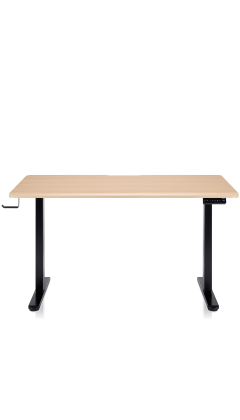
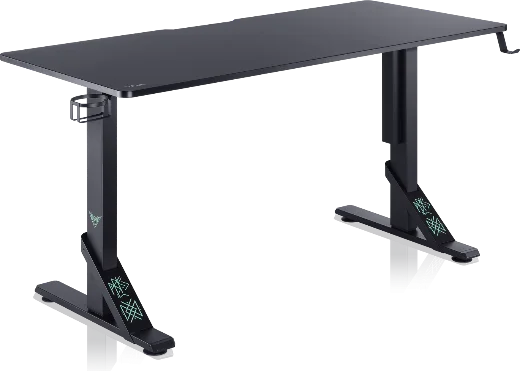
Crank-operated or single-motor desks are cheaper, but they are slower and usually less stable. With a crank, changing height is a chore and you end up barely using it. If you already know you'll always work seated, a solid fixed desk is a better buy than a cheap standing desk. For example, our SKULD, with three manual heights.
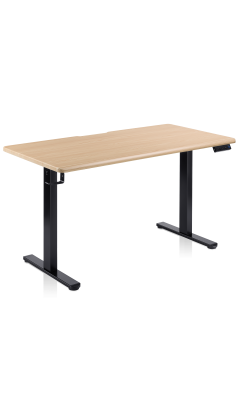
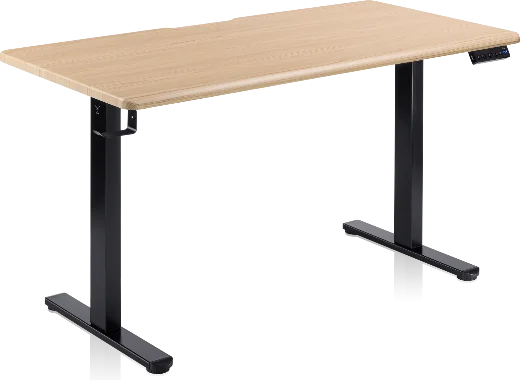
VORNA is our electric standing desk, and we designed it for one specific case: working or playing with a full setup, alternating between sitting and standing.
It isn't for everyone. If you are well under 1.70 m and don't want to use a footrest, if you need a desk smaller than 140 cm or if you'll be loading more than 75 kg, another type of desk will suit you better. If you want to get to know it in depth, we tell you all about it in its launch article.
Yes, if you spend many hours at your desk and will use it to alternate between sitting and standing. If you know you'll always be seated, your money goes further on a good fixed desk and a good chair.
Dual motor. It lifts more evenly, it is more stable at standing height and it handles unevenly distributed weight better. A single motor works for light loads and occasional use.
The height of your elbows with your arms bent at 90 degrees, both seated and standing. Measure both and check that the desk's range covers them.
There is no single figure. What works is changing posture often, for example every hour, instead of staying in the same position for a long stretch.
Quality dual-motor models usually stay below 50 dB, quieter than a normal conversation. VORNA moves below 45 dB.
Yes, as long as it has enough load capacity, a firm one-piece desktop and some way to keep the cables tidy.