














 en
Your cart
There are no more items in your cart
€419.90

On weekdays you spend more hours with your chair than with almost anyone, so it deserves a bit more thought than “the first one the search engine came up with”. There is no single best ergonomic chair for everyone, but there is a best one for the way you use it. An eight-hour day working from home doesn’t ask for the same thing as a small flat, an August heatwave or a desk where you work until six and game at eleven.
In this guide we go case by case: which feature matters in each situation, with figures, and which chair from our range fits. We’re manufacturers and we only talk about our own chairs, so we’re saying it up front. And when what you need is a different kind of chair, we’ll tell you that too.
Contents
| Your case | What to look for | At VALK |
|---|---|---|
| Long days working from home | Lumbar support that adapts to your posture, adjustable seat depth and a synchro mechanism with lock | MYLA |
| You get hot | Mesh on the seat and backrest, properly tensioned | NOMA or NOMA OFFICE |
| Studying or exam prep | Plenty of adjustment range, and a footrest if your feet don’t reach the floor properly | MYLA |
| Small space | A compact base and armrests that fit under the desk | MYLA |
| Tight budget | Lumbar, height and synchro, and cut back on extras | NOMA OFFICE |
| Working and gaming at the same desk | Multi-position lock, 4D armrests and an adjustable headrest | MYLA, or FREYA ELITE if you game reclined with a controller |
| Taller than 1.90 m | A seat that rises to 56 cm and a height-adjustable backrest | MYLA, up to 1.95 m |
Before going case by case, the non-negotiables. If a chair falls short on any of these points, it doesn’t matter how good it looks in the photo.
If you spend eight hours sitting, what matters most is lumbar support that follows you as you change posture, an adjustable seat depth and a synchro mechanism that lets you recline without losing support.
By four in the afternoon, nobody sits like the drawing in the ergonomics guide. You lean in to read, lean back on calls, and by the third meeting of the day you’re sitting however you can. That’s why it matters less that the chair is perfect in one position and more that it keeps up with you in all of them.
An adaptive lumbar support follows your back as you move; a fixed one only works if it matches the curve of your waist. Seat depth stops the edge of the seat pressing behind your knee, which is where dead legs begin. And a headrest that moves closer or further away takes the load off your neck when you lean back on a long call.
What to look for:
And one tip that costs nothing: the best posture is the next one. Get up every hour, even if it’s just to refill your water glass.
At VALK: the MYLA. It has adaptive lumbar support that adjusts itself to your weight and posture, a backrest that adjusts in height across 12 positions (6 cm), a seat that slides up to 5 cm and a 3D headrest that also moves closer to or further from your neck.
If you get hot, choose mesh, and make sure it’s on the seat as well: that’s where you notice it most.
In August, across much of Europe, the home office competes with the gym sauna, and wins. Fabric breathes much better than PU leather, but mesh lets air through the whole surface, back and thighs included. We compare them in detail in mesh or fabric chair.
Watch out for two details. First, tension: well-tensioned mesh supports you without you feeling the frame, while slack mesh ends up like a hammock. Second, the seat: some chairs pair a mesh backrest with a padded seat, which gains in cushioning and loses some ventilation. It’s a question of priorities.
If you still prefer the enveloping feel of a gaming chair, make it fabric. We help you decide in gaming, office or ergonomic chair.
What to look for:
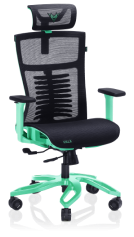
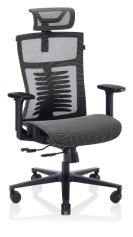
At VALK: all three have mesh on the seat and backrest. If heat is your main concern and you don’t need extras, start with the NOMA or the NOMA OFFICE, the same chair in two finishes: black with an aqua menthe frame, or grey with a black frame. The MYLA uses Flextex® mesh, which gradually adapts to your body and spreads the pressure.
For studying, prioritise adjustment range: a seat height and depth that adapt to whoever uses the chair, even if that person changes.
If the chair is for your son or daughter, they’ll grow faster than the chair pays for itself. Choose a wide height range and, if for now their feet don’t reach the floor properly, a footrest solves it in the meantime. Study desks tend to be small, so also check that the armrests fit under the desktop.
If you’re the one preparing for exams, apply everything from long working days and add one thing: you don’t always read your notes in the same position. A backrest that reclines and locks in several positions lets you read leaning back without losing support, and a footrest makes long revision afternoons easier to bear.
What to look for:
At VALK: the MYLA, with the widest height range in our ergonomic line-up (1.65 to 1.95 m), a sliding seat, a 5-position lock and an integrated footrest for breaks.
In a small space, check three measurements: the diameter of the base, the height of the armrests relative to the desktop and how much room the chair takes up when you recline.
Five centimetres of base seems like nothing until the chair shares a room with the bed, the wardrobe and the clothes horse. Office chair bases usually range from 60 to 72 cm in diameter, and every centimetre counts when you want to roll around without hitting the wall.
If the armrests go low enough or can be moved back, the chair slides under the desk and you get your floor back at the end of the day. With a standard desk, around 72 to 76 cm high, that’s the difference between a clear room and an obstacle course. And since in a small flat the chair is also part of the décor (and shows up in every video call), mesh and clean lines take up less visual space than a padded backrest.
What to look for:
At VALK: the MYLA, with the most compact base in our range (65 cm), an overall depth of 63 to 68 cm and reversible armrests: you can mount them crossed over to move the support back and get closer to the desk.
If budget rules, don’t cut back on what supports you (lumbar, seat height and synchro mechanism); cut back on extras you may not use.
An integrated footrest makes sense if you’re going to lie back for ten minutes after lunch; if not, it’s a very nice piece that gathers dust. The same goes for a jacket hanger or a headrest that adjusts in three directions when you’ll only ever use one.
Not every cheap chair is bad, but they usually fail in the same places:
That’s why it pays to look at what isn’t in the photo: a returns window long enough to try the chair properly (at VALK it’s 30 days, more than double the 14 required by law) and original spare parts once the warranty has ended. With spare parts, a worn part gets replaced; without them, you replace the chair.
What to look for:
At VALK: the NOMA OFFICE has the essentials without the extras: mesh on the seat and backrest, lumbar support adjustable in 4 positions, adjustable seat depth, synchro with lock and an aluminium base. It’s the most affordable chair in our ergonomic range. The NOMA is the same chair with an aqua menthe frame, if you fancy a touch of colour.
If you work and game in the same spot, you need a chair that changes posture with you: a multi-position lock, 4D armrests and a headrest that reaches your neck when you lean back.
At six you close the work laptop and at eleven you open Steam at the same desk (in between: dinner, the dishes and the negotiation over who puts the kids to bed). That’s daily life for a lot of people, starting with us. What you need is a desk chair that can handle the match, or a gaming chair that can handle the working day.
With keyboard and mouse, gaming looks a lot like working: back supported, elbows at desk height and screen at eye level. What works for the working day works for the match.
With a controller, everything changes. You lean back, your arms drop, your head looks for support and, ideally, so do your feet. That’s when the chair has to go from upright to reclined without a fight.
We make both, so we can say it plainly: neither is better, each suits a different way of using it. Here’s how our most complete ergonomic chair compares with our most complete gaming chair:
| Feature | MYLA (ergonomic, mesh) | FREYA ELITE (gaming, fabric) |
|---|---|---|
| Upholstery | Flextex® mesh | Breathable fabric over cold-moulded foam |
| Recline | Up to 135°, with the seat following up to 15° | Up to 160° |
| Mechanism | Synchro, 5-position lock | Multi-function, tilt up to 25° and 5-position lock |
| Lumbar support | Adaptive, built into the backrest | Memory foam lumbar cushion |
| Armrests | 4D, reversible | 4D, aluminium |
| Recommended height | 1.65 to 1.95 m | 1.70 to 2.00 m |
| Max. weight | 130 kg | 150 kg, certified to UNE-EN 1335 |
| Best for | Long working days and keyboard-and-mouse gaming | Long sessions reclined with a controller |
If your evenings are more controller than keyboard, a gaming chair will suit you better. We compare them all in best value gaming chairs 2026, and the comparison by family, including the classic office chair, is in gaming, office or ergonomic chair.
At VALK: the MYLA covers both shifts best: synchro with a 5-position lock and adjustable tension, 4D armrests that turn inwards, a headrest that moves towards your neck across 8 positions and an integrated footrest. And if you game reclined more than sitting up, the FREYA ELITE.
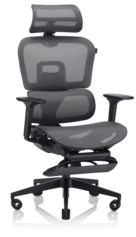
Three chairs, all with mesh on the seat and backrest, a synchro mechanism and UNE-EN 1335 certification. The MYLA is the most complete; the NOMA and NOMA OFFICE are the same chair in two finishes, focused on the essentials.
| Feature | MYLA | NOMA | NOMA OFFICE |
|---|---|---|---|
| In one line | The most complete | The essentials, with colour | The essentials, in sober grey |
| Recommended height | 1.65 to 1.95 m | 1.65 to 1.90 m | 1.65 to 1.90 m |
| Seat height * | 48 to 56 cm | 46 to 54 cm | 46 to 54 cm |
| Seat depth | Up to 5 cm, 4 positions | Up to 4 cm, 4 positions | Up to 4 cm, 4 positions |
| Backrest | Height-adjustable, 12 positions (6 cm) | Fixed height | Fixed height |
| Lumbar support | Adaptive, no controls | Adjustable in 4 positions | Adjustable in 4 positions |
| Headrest | 3D: height, depth and tilt | Height (10 cm) and tilt | Height (10 cm) and tilt |
| Armrests | 4D, reversible | 3D | 3D |
| Footrest | Integrated and folding | No | No |
| Recline | Up to 135°, seat up to 15° | Up to 135°, seat up to 10° | Up to 135°, seat up to 10° |
| Lock | 5 positions | 4 positions | 4 positions |
| Base and castors | 65 cm aluminium base, 60 mm castors | 72 cm aluminium base, 75 mm castors | 70 cm aluminium base, 65 mm castors |
| Max. weight | 130 kg | 120 kg | 120 kg |
| Colours | Grey with black frame, or white with grey frame | Black with aqua menthe frame | Grey with black frame |
* Seat heights measured without compressing the mesh.
All three are in our ergonomic chairs category, with all the photos and measurements.
A good chair badly adjusted is just an ordinary chair. This is the order we recommend:
And the screen: top edge at eye level or slightly below. You’ll find it step by step in how to sit properly and protect your posture.
It depends on how you use it, which is why this guide goes case by case. If you spend long hours sitting, look for adaptive or adjustable lumbar support, adjustable seat depth and a synchro mechanism with lock. In our range, the most complete is the MYLA; if heat or budget come first, the NOMA OFFICE.
An office chair can be any chair on castors. An ergonomic chair adapts to whoever uses it: seat height and depth, lumbar support, armrests and a mechanism that follows you as you recline. The difference isn’t in the looks, it’s in how many adjustments it has and how well they work.
For long working days and keyboard-and-mouse gaming, an ergonomic mesh chair. For long sessions reclined with a controller, a gaming chair, which reclines further and wraps around you more. We go into it in gaming, office or ergonomic chair.
Mesh breathes better and spreads pressure elastically, so it’s the best option if you get hot. A padded chair with good foam is softer and more enveloping. If you go padded, choose fabric over PU leather. We compare them in mesh or fabric chair.
It moves the seat and backrest together but at different angles: when you recline the backrest, the seat tilts less, so your back keeps its support and your feet stay on the floor. It’s the standard on ergonomic chairs.
It’s the number of directions they adjust in. On our chairs, 4D means height, sideways movement, forwards and backwards, and turning inwards. 3D armrests have three of those four adjustments.
Check the recommended height and the maximum seat height. The MYLA is designed for people up to 1.95 m, with a seat that rises to 56 cm and a height-adjustable backrest. If you’re taller than 1.95 m, look at the FREYA ELITE: it’s a gaming chair, but it’s designed for people up to 2 metres. We break it down in choosing the right chair for your height and weight.
Whatever its spec sheet says, ideally certified. The MYLA takes 130 kg, and the NOMA and NOMA OFFICE 120 kg. If you’re close to the limit, go up a step: in our range, the one that holds the most is the FREYA ELITE, with 150 kg certified to UNE-EN 1335.
It isn’t a treatment. What a good chair does is make it easy to sit well and change posture without losing support, which is what helps most on long days. If you have persistent pain, see a health professional before buying anything.
For work chairs, the reference is the European standard UNE-EN 1335, with stability, strength and durability tests. All three of our ergonomic chairs are certified to it.
With daily use, several years if the frame and mechanism are good. What usually ends a chair’s life is a wear part, such as the gas lift, the castors or the armrests, so it matters that they can be bought separately. You’ll find them in spare parts.
At VALK you have 30 days from delivery, more than double the 14 required by law for online purchases. That’s plenty of time to try it over real working days. The conditions are in returns.
The figures for each chair come from our technical spec sheets and quality-control measurements, not from estimates. The standard we refer to is UNE-EN 1335.
We only talk about our own chairs, and we say so openly: this isn’t an impartial comparison, it’s a guide to what to look for, written by people who design chairs in Europe. That’s why, when a different kind of chair suits you better, like a gaming chair for playing reclined, we tell you that too.
Last updated: October 2026.
If you’re not sure which one fits your day, write to us from the VALK Help Centre and we’ll help you choose. We’re the manufacturer: we know a thing or two about this.